By Kate Jones
Flashcards are a teaching and learning technique involving the use of paper or digital resources to support the consolidation of curriculum content and recall of information from long term memory. Retrieval practice refers to the act of recalling learned information from memory (with no or little support) and every time that information is retrieved, or an answer is generated, it changes that original memory to make it stronger.
The benefits of retrieval practice for long-term learning are among the most secure findings in educational psychology (Brown, Roediger, & McDaniel, 2014) and flashcards are a student friendly method of providing regular retrieval practice opportunities for learners.
The Great Teaching Toolkit: Evidence Review (Coe et al., 2020) suggests that great teaching involves activating hard thinking. This can be achieved through the use of questioning to promote elaboration and connected, flexible thinking in addition to using questions to elicit student thinking and evidence of understanding or long-term learning as learners develop knowledge and expertise. Flashcards can be used to activate hard thinking, in a classroom, with peers or as part of independent study.
However, as with most things in education it is important to take care when it comes to encouraging students to use flashcards, as this technique can be misunderstood and vulnerable to ‘lethal mutation’. Flashcards can be an effective learning intervention but that depends on how students use them, when they are used by students and what content is included.
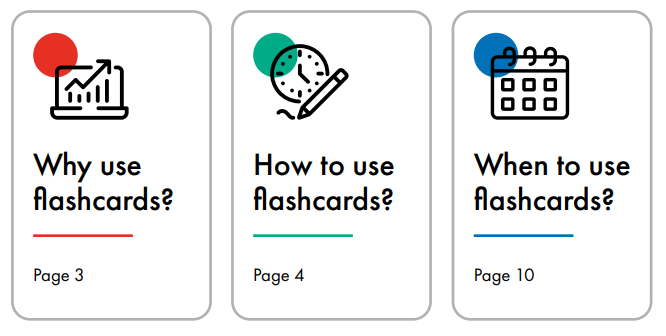
This eBook will cover the following:
What next?
What next?
Your next steps in becoming a Great Teaching school